

INTRO
I decided to put this page together to focus on the projects that are more creative tech–driven.
They sit at the intersection of creativity, technology, and retail — areas I’ve been exploring and leading throughout my career. Some of these ideas were never fully realized for different reasons, which is why they don’t appear elsewhere.
I wanted to share them here because they represent the kind of creative and technical thinking I enjoy most — where design, storytelling, and innovation come together to shape new experiences.
This felt like the best way to give a more complete picture of how I think, build, and collaborate, where design, code, and emotion meet.
WAYS OF WORK
My process is deeply collaborative and always anchored in the prototype stage — where creative intent meets technical reality. I stay closely involved from early scoping to live testing, working hands on, side-by-side with developers and engineers to align design, behavior, and brand expression.
I regularly visit prototypes — whether it’s a hardware installation, generative system, or retail interaction — to evaluate visuals, motion, and user response in real time. Feedback from these sessions is looped directly into the dev process, refining both system logic and creative detail.
For me, prototyping isn’t a technical checkpoint — it’s a shared creative space where art direction, storytelling, and technology evolve together. This hands-on collaboration builds stronger outcomes and ensures every experience feels alive, relevant, and on-brand.
CONCEPT CREATION / CREATIVE LEAD
H&M BRAND TEMPLE
H&M has several store formats, each serving a distinct purpose — from driving everyday convenience to building long-term brand connection. Together, they form a strategy that balances immediate transactions with lasting brand equity. Among these formats, there used to be one called Brand Temple.
The Brand Temple was conceived as H&M’s ultimate retail expression — designed to embody the brand’s vision, creativity, and purpose in physical form. More than a store, it was envisioned as a cultural and experiential hub where fashion, art, sustainability, and innovation converge. Visitors would immerse themselves in H&M’s universe through events, exhibitions, and creative activations that extend far beyond shopping. Acting as both a brand museum and a creative laboratory, the Brand Temple aimed to showcase leadership in design, digital integration, and community engagement — a bold statement of intent to inspire, connect, and redefine the future of fashion retail.
H&M planned to establish Brand Temples in a few key cities worldwide — including New York City, where I served as Creative Lead. The initiative aimed to represent the brand’s next evolution in physical experience. I developed and presented the internal creative concept to senior management, defining both the strategic direction and the visual narrative.
As part of this process, I collaborated with and evaluated several international agencies across Europe and the U.S. — including Bulletproof, B-Reel, Kettle, and Hovercraft — to identify the right creative partner for the project.
Although the Brand Temple NYC project was later discontinued and repositioned as a Local Flagship with select upgrades, much of the creative foundation and vision developed during this phase continued to inform the final outcome.
CONCEPT CREATION / CREATIVE LEAD
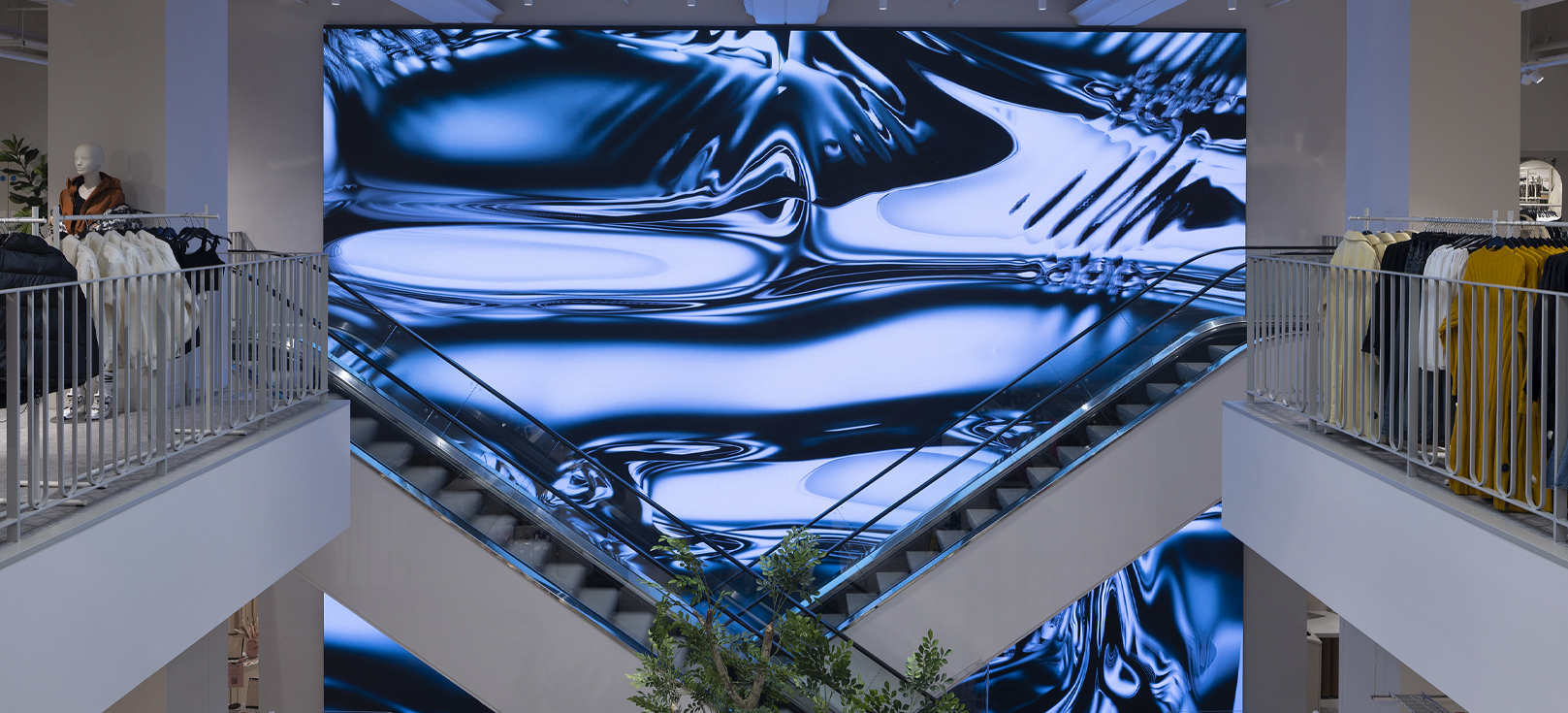
H&M INFINITE DREAMS (SELF-GENERATIVE SCREEN)
An interactive digital artwork developed for H&M’s flagship store on Regent Street, London — created in collaboration with Hirsch & Mann and Variable.
Part of H&M’s exploration into the fusion of fashion and technology, Infinite Dreams transforms a large LED wall into a living, live self-generating digital fabric.
Powered by a real-time physics simulation, it reacts to people moving on the escalators, creating endless, non-repeating compositions inspired by the motion of cloth.
The system runs on a custom generative engine that uses live data — such as time of day, season, and campaign themes — to adapt the visual mood and behavior of the artwork, keeping it always contextually aligned with the store environment.
This interactive installation has also been reproduced at H&M’s Head Offices in Stockholm and at H&M Passeig de Gràcia in Barcelona, extending the concept into new contexts across the brand.
My role: Collaborating closely with the tech team, providing creative feedback on visual results and effects, and aligning the evolving generative content with ongoing campaigns to ensure aesthetic and brand consistency.

CONCEPT CREATION / CREATIVE DIRECTION
H&M SOUNDTRACK YOUR STYLE / IMMERSIVE FITTING ROOM
This concept was developed as part of H&M’s Immersive Fitting Room project — an innovation initiative exploring how technology and creativity could redefine the in-store experience.
The original idea envisioned a fully interactive experience where the clothes themselves would “choose” the music and video, generating personalized content in real time based on the garments detected in the fitting room. However the concept was later simplified into a screen-based interaction only, focusing on the storytelling and user experience elements rather than full system integration.
CONCEPT
An interactive retail experience designed to turn fashion data into music and video content — where we would translate your style into content, making every shopping session unique and emotionally engaging by letting garments “compose” their own soundtrack.
HOW IT WORKS
One RFID reader placed inside the IFR near the door identifying the garments a customer brings and another by the screen/mirrors so we could know what the customer was wearing.
Each garment is linked to a music stem (e.g., vocals, bass, drums).
When combined, AI generates a unique song from those stems.
Changing even one garment alters the entire soundtrack, shifting the mood and rhythm to match the customer’s evolving style.
There would be also several videos to be applied to the music genres combinations.
GOAL
To engage younger audiences, merging fashion, data, and sound into a multisensory experience — transforming the fitting room into a space of creativity, personalization, and emotional connection.
CONCEPT CREATION / ART DIRECTION
METRO WIND POWER
INTRO
How great would be if we could use something we produce but actually waste?
Every day, more than 1,200 trains rush through Stockholm’s metro tunnels at speeds up to 80 km/h through 50km underground stations in Stockholm, pushing massive volumes of air through enclosed spaces. That energy simply vanishes — dispersed as turbulence, pressure, and noise.
This project reimagines that wasted force as renewable power, asking a simple question: What if every passing train could help power the city it moves through?
CONCEPT
“Metro Wind Power” is an urban sustainability concept that explores how the airflow from moving trains can be transformed into clean electricity.
By placing compact wind turbines in strategic tunnel locations, the system captures this constant kinetic flow and converts it into power for lighting, signage, and digital installations within the station.
The result: an everyday movement turned into an everyday energy source — and a powerful brand statement about innovation, sustainability, and circular thinking.
HOW IT WORKS
Turbine Placement: Small turbines are safelly installed along tunnel walls or ventilation shafts where airflow peaks as trains arrive and depart.
Energy Capture: Each turbine can generate between 20–100 watts, depending on airflow and frequency, creating a modular system that scales across tunnels.
Energy Use: The produced electricity powers LED lighting, ambient art, or digital displays, visibly linking sustainability to the commuter experience.
DESIGN & INTEGRATION
The pilot location is T-Centralen, Stockholm’s busiest metro hub — a perfect testbed due to its high train frequency and long, enclosed tunnels.
The turbines would be architecturally designed to blend technology and aesthetics, featuring illuminated blades or light rings that visualize energy flow in real time — turning infrastructure into an educational and artistic element.
GOAL
The primary goal is to build awareness and positive brand positioning by showing how wind power can be practical, beautiful, and integrated into everyday life.
By using the metro — one of the city’s most symbolic systems — this project promotes sustainability to a wider public audience, highlighting how renewable energy can emerge from places we least expect.
A secondary goal is to reduce metro stations’ energy consumption, gradually replacing a portion of their power needs with the energy generated by the trains themselves — creating a circular system that powers mobility with its own movement.
I’d be more than happy to walk you through these projects in detail — how the ideas came to life, what challenges they addressed,
and how they could evolve further.
If you’d like to discuss them, exchange thoughts, or simply explore possibilities together, I’d love to meet and continue the conversation.
Tiago Oliveira
hello@tiagois.me
LinkedIn ↵